Hercules, Lovable, and Salesforce's own AI builders are making software construction easier. The bigger change is what clients may need experts to do next.
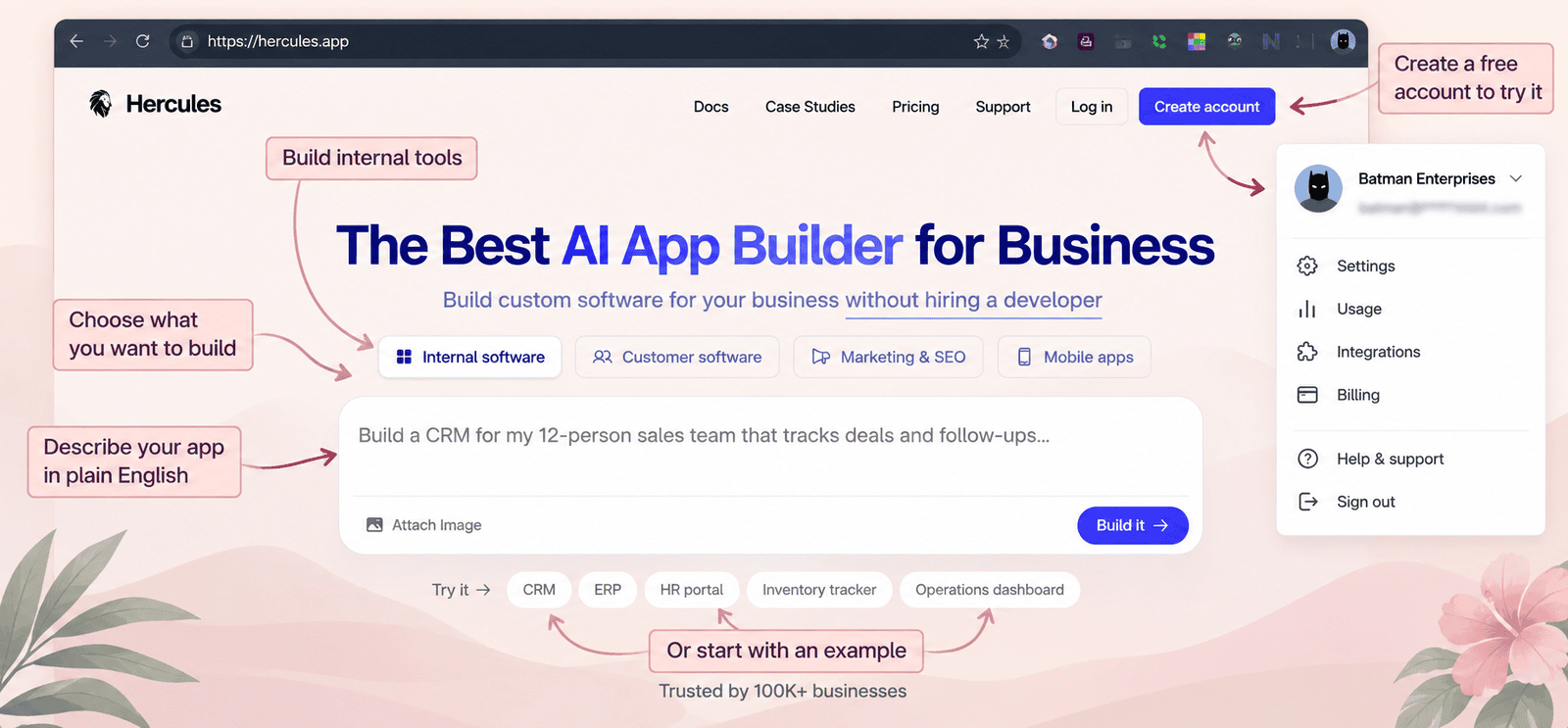
The question that stopped me:
If a 12-person sales team can describe the CRM it wants in plain English and have an AI builder generate the interface, database, roles, workflows, and deployment, what exactly should that company still be paying a CRM consultant to do?
The prompt is no longer “configure my CRM.” It is “build me one.”
That distinction matters. Hercules currently markets itself with a prompt that reads, “Build a CRM for my 12-person sales team that tracks deals and follow-ups.” Its public product page says the platform can generate and host apps with authentication, backend services, a database, roles and permissions, payments, email, API integrations, analytics, scheduled events, and other application infrastructure. [1] Hercules also says its Cloud layer includes hosting, database, backend functions, authentication, AI, and email. [2]
Lovable makes a similar promise. Its app-builder documentation says a user can describe an application and receive screens, data, logic, authentication, and hosting from a chat-based workflow. It can connect outside tools and can sync code to GitHub so developers can review, extend, or move the codebase later. [3][4]
These claims do not mean every AI-generated business app is automatically production-ready, secure, maintainable, or cheaper over its full lifecycle. They do mean something important has changed: a basic business application is increasingly something a knowledgeable operator can generate and iterate on instead of commissioning from scratch.
This is already reaching CRM, not just prototypes
One of the clearest examples comes from Lovable itself. In a vendor-published customer story, startup Atonom says it replaced a roughly $40,000 annual Salesforce contract with a Lovable-built CRM costing about $1,200 annually. The system handles lead capture, account and opportunity creation, recurring-revenue tracking, pipeline probabilities, weekly focus flags, dashboards, and basic reporting. [5]
That example should be treated as a customer case study, not an independent benchmark. The same caution applies to Hercules case studies. Hercules publishes examples of non-developers building internal operating systems, ERPs, portals, and CRM functionality, including Global Connectors, which says its founder built an ERP with sales, purchasing, inventory, HR, CRM, treasury, and client-portal functions in about a month. [6]
Still, the pattern is difficult to ignore. These platforms are competing for work that used to require some combination of SaaS subscriptions, implementation consultants, custom developers, and ongoing administrators.
I have been testing this shift myself
My own experiment has been smaller than an ERP replacement, but it made the change feel very real. In less than two weeks of learning and building in Lovable, I created a multi-brand content-operations system for Aloha CRM. The workflow covers planning, research inputs, article and course production, fact-check and recheck states, human review, queues, recurring work, duplicate prevention, and publishing handoffs.
I also used it to generate course structures and lesson drafts, including a Salesforce ecosystem course structure with seven modules and 50 lessons. The point is not that every output was perfect. It was not. I spent significant time correcting weak outputs, tightening the fact-checking logic, revising workflows, and teaching the app how I wanted the work handled.
And the build could have moved faster. I was deliberately budgeting credits across multiple AI products while experimenting, so I was not letting any one builder run without limits. Even with that constraint, I went from ideas in my head to functioning business software at a pace that would have been unrealistic for me if every change required a developer ticket.
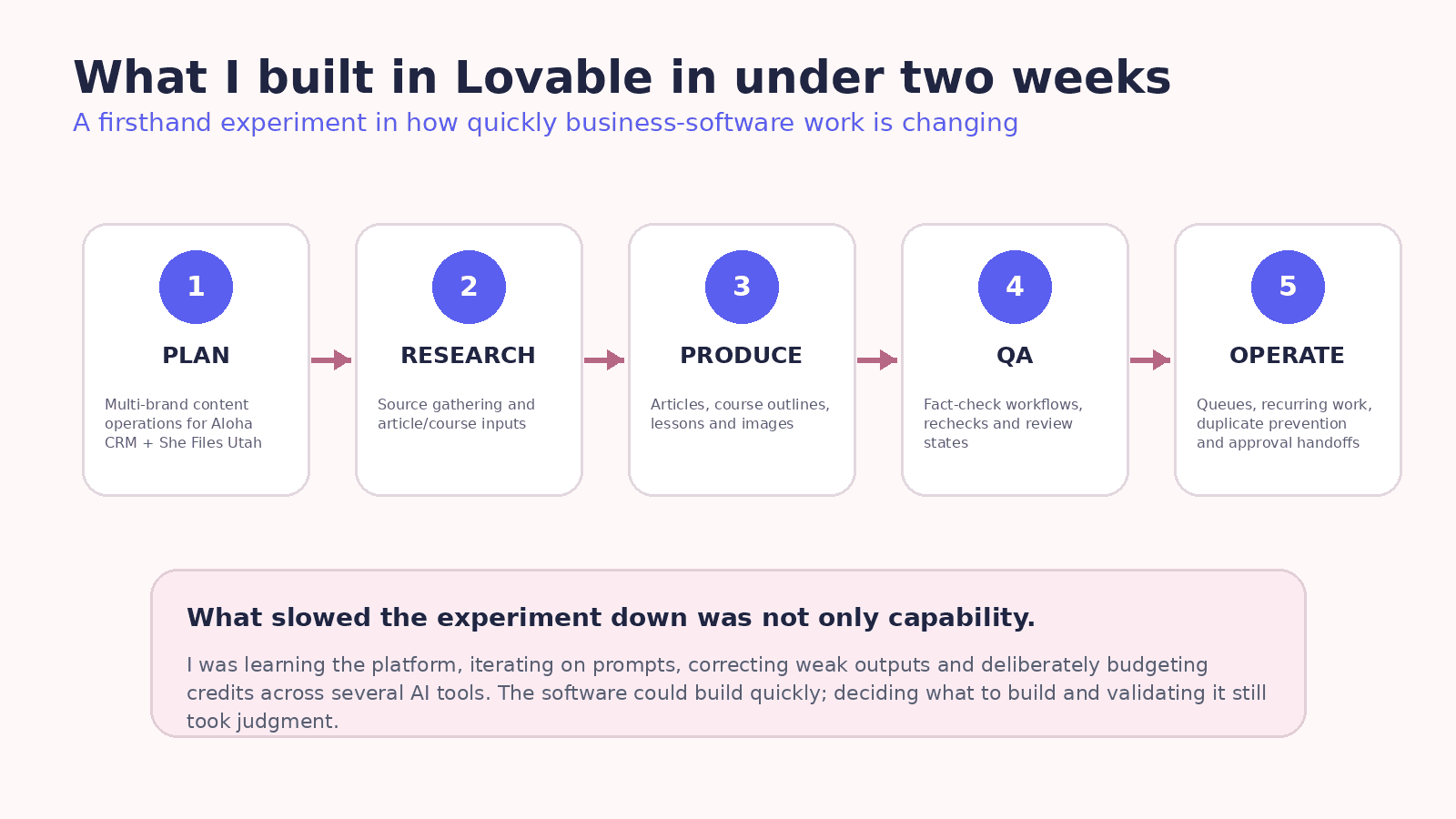
The lesson from the experiment The app could generate a surprising amount of software. The hard part kept moving upstream: deciding the workflow, spotting bad assumptions, defining quality standards, and correcting the system when it produced something plausible but wrong. |
So, is this a threat to Salesforce?
For some use cases, yes. For the Salesforce ecosystem as a whole, the answer is more complicated.
A small or midsize company that needs a relatively straightforward sales pipeline, follow-up tracking, forms, dashboards, approvals, and a few integrations now has more credible alternatives to buying a large CRM platform and paying for an implementation. The Atonom example shows that at least some companies are already making that tradeoff. [5]
But Salesforce is not standing still, and it is not treating AI app builders only as competitors. Salesforce now offers Agentforce Vibes, which uses natural language to generate code and applications inside the Salesforce environment. [7] Its Builder Central beta lets admins and developers build and deploy apps and agents through natural-language, low-code and no-code interactions while inheriting Salesforce permissions and security controls. [8]
Even more telling, Salesforce announced an open Headless Toolkit and AgentExchange ecosystem in September 2026, explicitly naming Lovable among the AI builders that can create experiences on top of Salesforce. Salesforce says these interfaces can use Salesforce data, workflows, business logic, permissions, security, and governance. [9] Lovable separately announced that its Salesforce integration can keep Salesforce as the system of record while teams build new interfaces and agents around it. [10]
That makes the future look less like “Salesforce versus Lovable” and more like a spectrum. A company might replace Salesforce for a lightweight use case. Another might keep Salesforce as the governed data and logic layer while using Lovable to create a faster, purpose-built user experience. A third might stay entirely inside Salesforce and use Builder Central or Agentforce Vibes to generate what previously required manual configuration or development.
![Figure 4. Conceptual model based on Salesforce's September 2026 Headless Toolkit, Builder Central, and Lovable partnership announcements. [8][9][10]](/salesforce_composable_model.png)
The easy configuration work is the part most exposed
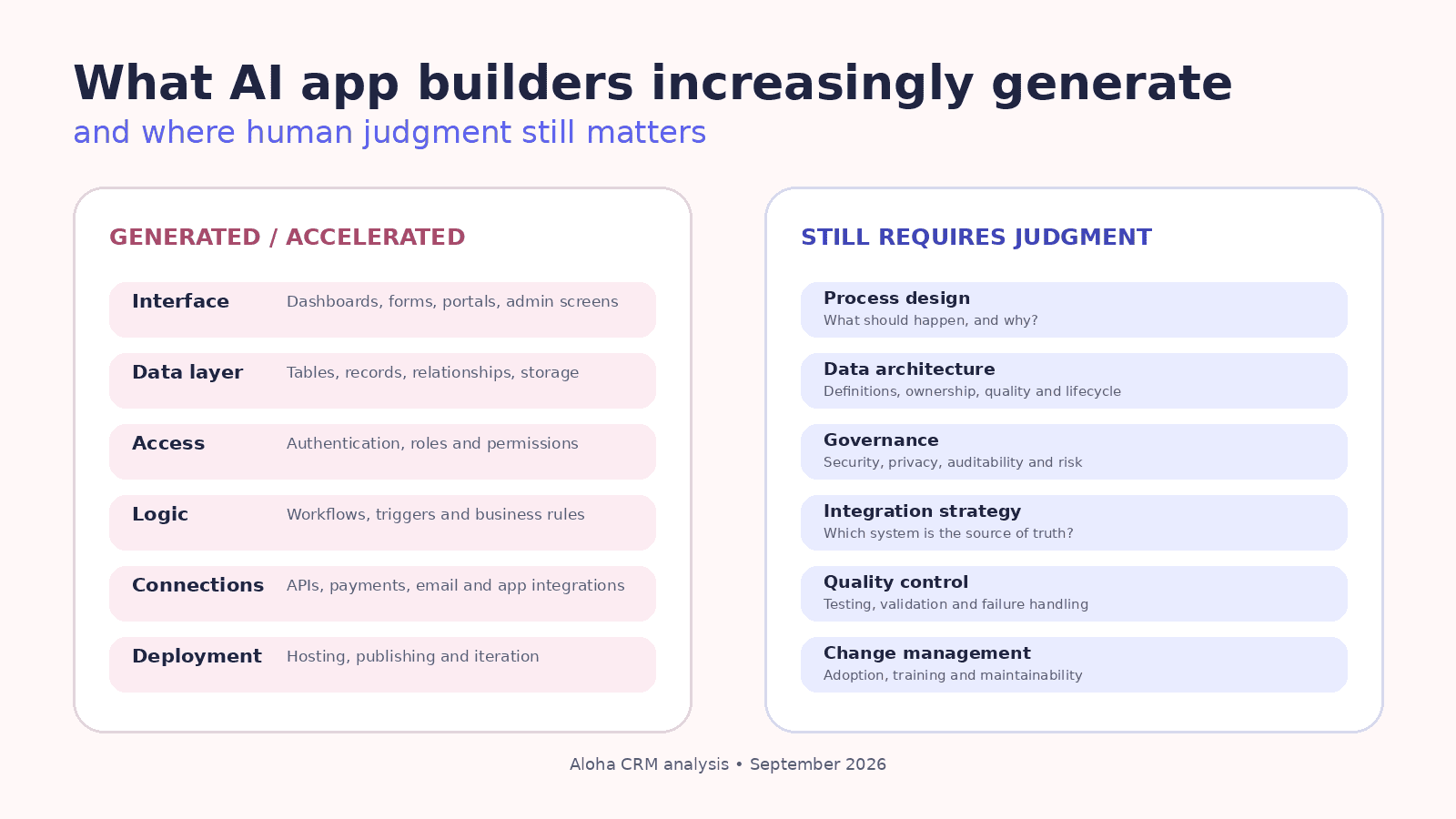
The most vulnerable consulting work is the work that can be described clearly and generated repeatedly: standard objects and fields, basic forms, dashboards, straightforward workflows, simple portals, common integrations, and lightweight internal tools. That does not mean these tasks disappear. It means the amount of human labor required to produce them can fall.
Salesforce's own research describes a similar shift for developers. In its 2026 State of IT report, Salesforce says nearly one-third of developers in its survey already used AI for code generation, and it describes a move from hand-coding every feature toward reviewing, orchestrating, and safeguarding AI-assisted builds. [11]
The admin role is also being described in more business-oriented terms. In a September 2026 Salesforce Admins discussion about the job market, recruiters emphasized requirements literacy, business impact, and the ability to make recommendations rather than simply execute configuration requests. [12] Salesforce Trailhead likewise describes admins as responsible for users, data, security, analytics, automation, optimization, and trusted solutions, not just setup clicks. [13]
More exposed to automation | More dependent on human judgment |
Creating routine fields, screens, and forms | Defining the business process before anything is built |
Generating standard CRUD workflows | Designing a durable data model and ownership rules |
Building basic dashboards and portals | Choosing the right platform and system of record |
Connecting common services through standard integrations | Designing integration boundaries, error handling, and data governance |
Producing first-pass code or configuration | Testing, security review, auditability, release discipline, and long-term maintainability |
Translating a clear specification into an app | Discovering what users actually need when the specification is unclear or wrong |
There is an important reality check: AI speed is not the same as software quality
The evidence on AI-assisted development is more nuanced than the marketing. Google's DORA research has found associations between greater AI adoption and improvements in individual productivity, documentation, code quality, and review speed, while also warning that AI does not automatically improve software delivery and that strong engineering practices still matter. [14]
A 2025 randomized study from METR even found that experienced open-source developers working in mature codebases took 19% longer when they were allowed to use the AI tools available at that time. METR later said newer 2026 data was too affected by selection bias to produce a clean estimate, although the researchers believed newer tools were probably providing more acceleration than the earlier study captured. [15][16]
Those findings are not contradictory to the rise of AI app builders. Greenfield business apps, mature open-source repositories, enterprise CRM environments, and one-person prototypes are different kinds of work. The responsible conclusion is not “AI always makes development faster.” It is that AI is rapidly expanding who can build software and which parts of the build process can be automated, while verification, context, and governance remain critical.
What this means for Salesforce consultants and admins
The safest career strategy is not to compete with an AI builder on how quickly you can create a field. Learn to use the builders, then move your value higher in the decision chain.
• Requirements literacy: Turn vague stakeholder requests into testable business requirements. Challenge requests that solve the wrong problem.
• Process architecture: Map what should happen before choosing what object, flow, agent, or application should implement it.
• Data architecture and governance: Know what the source of truth is, how records relate, who owns data quality, and who should be allowed to see or change what.
• Platform selection: Know when a company needs Salesforce, when Zoho or another packaged CRM is enough, and when a purpose-built app is reasonable.
• Integration design: Understand APIs, identity, permissions, synchronization, failure handling, and the risks of duplicating data across systems.
• Testing and release discipline: AI-generated systems still need acceptance criteria, security review, regression testing, monitoring, documentation, and controlled deployment.
• AI-builder fluency: The consultant who can responsibly generate and inspect working software can test recommendations faster than the consultant who only writes a requirements document.
The consulting moat is moving
For years, part of the value of CRM consulting came from knowing how to make the software do something the client could not make it do alone. That knowledge still matters, especially in complex Salesforce environments. But the construction barrier is falling.
The durable advantage is increasingly the ability to answer harder questions: What should we build? What should we buy? What should stay in Salesforce? What can live outside it? What data is authoritative? What will break at scale? What needs governance? What should never be automated?
That is why I do not think AI app builders make CRM expertise irrelevant. I think they expose the difference between platform configuration and systems expertise.
My takeaway The era of charging premium rates simply because business software is difficult to construct is weakening. The next era rewards people who can understand the business, choose the right architecture, use AI to build faster, and still know when the output is wrong. |
Sources and fact-check notes
All product capabilities and announcements below were checked against current official sources on September 24, 2026. Customer results from Hercules and Lovable are clearly treated as vendor-published case studies rather than independent audits.
• 1. Hercules, product homepage — https://hercules.app/
• 2. Hercules, Cloud launch and infrastructure — https://hercules.app/changelog/hercules-cloud
• 3. Lovable, AI App Builder — https://lovable.dev/build/app-builder
• 4. Lovable, code ownership / GitHub workflow — https://lovable.dev/guides/build-ai-applications-without-coding-team
• 5. Lovable customer story: Atonom CRM replacement — https://lovable.dev/en/customers/atonom
• 6. Hercules customer story: Global Connectors / Compta 360 — https://hercules.app/customers/global-connectors
• 7. Salesforce, Agentforce Vibes — https://www.salesforce.com/agentforce/developers/vibe-coding/
• 8. Salesforce, Builder Central — https://www.salesforce.com/headless/builder/
• 9. Salesforce, AIforce / Headless Toolkit / AgentExchange announcement — https://www.salesforce.com/ap/news/press-releases/2026/09/16/sg-salesforce-unveils-aiforce-bringing-the-full-power-of-its-platform-to-any-interface/
• 10. Lovable + Salesforce partnership announcement — https://lovable.dev/blog/salesforce-partnership
• 11. Salesforce, State of IT: AI and App Development Trends 2026 — https://www.salesforce.com/platform/state-of-it-ai-app-development/summary/
• 12. Salesforce Admins, admin job market discussion, Sept. 10, 2026 — https://admin.salesforce.com/blog/2026/what-does-the-salesforce-admin-job-market-look-like-right-now-podcast
• 13. Salesforce Trailhead, Salesforce Admin role — https://trailhead.salesforce.com/content/learn/modules/salesforce-admin-quick-look/learn-about-the-salesforce-admin-role
• 14. Google Cloud DORA, generative AI in software development — https://cloud.google.com/blog/products/ai-machine-learning/sharing-new-dora-research-for-gen-ai-in-software-development
• 15. METR, 2025 randomized developer-productivity study — https://metr.org/blog/2025-07-10-early-2025-ai-experienced-os-dev-study/
• 16. METR, 2026 update on developer-productivity experiment design — https://metr.org/blog/2026-02-24-uplift-update/
Publishing note: Product features change quickly. Recheck pricing, packaging, beta availability, and integration details before republishing this article far in the future.