
If you've never touched your opportunity stages, you're running your pipeline on Salesforce's defaults: Prospecting, Qualification, Needs Analysis, Value Proposition, Id. Decision Makers, Perception Analysis, Proposal/Price Quote, Negotiation/Review, Closed Won, Closed Lost.
Ten stages. Be honest: can anyone on your team explain the difference between "Value Proposition" and "Perception Analysis"? Neither can I, and I do this for a living.
Why the defaults fail small businesses
The default stages describe what the seller is doing, not what the buyer has agreed to. "Needs Analysis" means your rep is analyzing. It says nothing about whether the deal moved. That's how you end up with a pipeline full of deals sitting at 50% that were never real.
And here's why that's expensive: Stage isn't just a label. It drives Probability, Forecast Category, and whether Salesforce counts the deal as open or closed. When reps interpret stages differently, every forecast and pipeline report built on top inherits that guesswork. Leadership thinks "70%" means something. It means whatever each rep felt like that day.
For a 5 to 50 person company, ten stages is also just too many. Reps guess, everyone guesses differently, and your reports become fiction.
What each column actually does (and why you should care)
When you open Setup and look at the stage picklist, you see more than names:
Stage Name is the label reps see. Make it describe a meaningful, observable point in the deal, not a vague activity your rep is working on.
API Name is the behind-the-scenes value automations and integrations can reference. Renaming the label doesn't change it, and that's by design: you can make the wording friendlier for reps without touching the value external systems may depend on. Be far more careful changing API names than labels.
Type tells Salesforce whether the stage is Open, Closed/Won, or Closed/Lost. This drives what counts as "still in play" everywhere in the system.
Probability is the default win likelihood for that stage, and it feeds your weighted pipeline math. Salesforce lets users with edit access override it on individual deals, but think hard before allowing that. If every rep decides what 70% means, you've reintroduced the exact subjectivity you were trying to remove.
Forecast Category groups stages into forecast buckets: Pipeline, Best Case, Commit, Closed, Omitted. Most orgs ignore this column completely, then wonder why the forecast doesn't match reality.
The fix: fewer stages, defined by observable milestones
A stage should represent an observable change in the deal, not a vague description of what the rep is working on. If a stranger couldn't verify it from the record, it's not a stage gate.
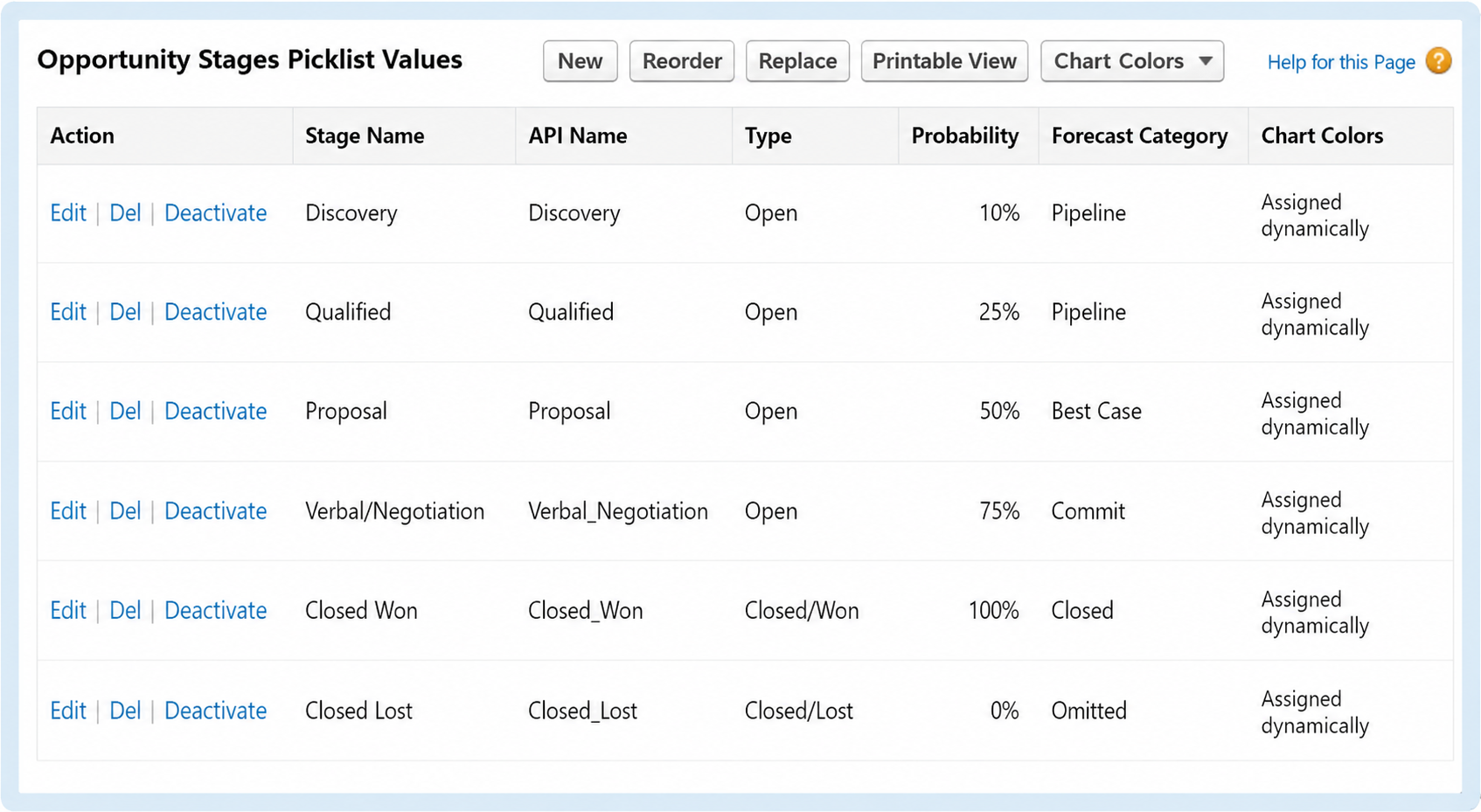
Here's a five-stage model that works for most small B2B sales teams:
| Stage | It means | You can prove it because | Probability |
|---|---|---|---|
| Discovery | We've talked and there's a real problem | Meeting happened, problem documented | 10% |
| Qualified | Real problem, plausible fit, a known buying process, and a reason to act | Decision maker and decision process identified | 25% |
| Proposal | They have our price and scope in hand | Proposal sent, review scheduled | 50% |
| Verbal/Negotiation | They said yes, terms in motion | Verbal commit or redlines received | 75% |
| Closed Won / Closed Lost | Signed, or dead | Signature, or a documented loss reason | 100% / 0% |
On qualification: notice I didn't require confirmed budget. In consulting and complex B2B, your proposal is often what lets the champion get the budget. Track budget, timeline, and business impact in Opportunity fields and surface them as Key Fields in Path instead of making them the price of admission.
Notice also what's missing: no "Prospecting" stage. For most small B2B teams, if you haven't had a real conversation yet, it belongs in Leads, not Opportunities. (There are legitimate exceptions, like renewals and account-based plays that create opportunities early.) Keeping wishful thinking out of the pipeline is half the battle.
Stage examples by industry
The five-stage model is the skeleton. Your industry decides what the middle stages look like, because different businesses have different deal milestones. More stages aren't automatically better. Every additional stage should represent a meaningful distinction you actually want to measure; if two stages don't tell you something different about conversion, velocity, or where deals stall, why are you collecting the distinction?
Professional services / consulting (like mine) Discovery Call → Needs Assessment → Proposal Sent → Verbal Agreement → Closed Won/Lost The assessment stage matters because scope is the deal. Nothing goes to Proposal until the problem is documented.
SaaS / software Demo Scheduled → Demo Completed → Trial/Proof of Concept → Contract Sent → Closed Won/Lost The demo and trial are the buyer milestones. A trial stage carries real delivery cost, so it deserves its own gate.
Real estate Inquiry → Showing Scheduled → Showing Completed → Offer Submitted → Under Contract → Closed Showings and offers are the observable events. Negotiation here includes inspections and counter-offers, so Under Contract is its own stage.
Construction / contractors RFP or Site Visit → Go/No-Go Decision → Bid Prepared → Bid Submitted → Presentation/Q&A → Awarded/Not Awarded The Go/No-Go stage is the money-maker: it forces the team to decline low-odds bids before burning estimating hours.
Agencies / creative Discovery → Scope Defined → Proposal/Pitch → Negotiation → Closed Won/Lost Agencies die from scope creep, so "Scope Defined" is the stage that earns its keep.
Notice the pattern: the middle stages change, but every version is built around milestones you can verify on the record: a showing happened, scope was defined, a bid went out, a trial started. Not vague descriptions of rep effort.
Three rules when you customize
- Every stage needs an exit criterion a stranger could verify. "Had a good call" is not a criterion. "Proposal sent and review meeting on the calendar" is.
- Different sales motions get different processes, not more stages. If you sell both new business and renewals, use Record Types with separate Sales Processes instead of cramming both into one bloated picklist.
- Put the definitions in Path, and enforce the few that matter. Use the Path component at the top of the opportunity page to show each stage's definition, key fields, and exit criteria. Your process doc can be ignored. The Path is sitting in front of the rep while they're working the deal. Then, for the handful of criteria that genuinely must be met, add validation rules so an opportunity can't advance without the required information.
The payoff
Clean stages give you a forecast you can trust, reports that show where deals actually stall, and a pipeline review that takes fifteen minutes instead of an hour of arguing about what "Perception Analysis" means.
If your stages haven't been touched since the org was set up, that's exactly the kind of thing a CRM health check catches.