A practical guide to platform ownership, shared responsibility, and stopping role creep before it becomes the job description.
The CRM touches nearly every part of the business. That does not mean the CRM administrator owns every decision that touches the CRM. |
CRM administrators are often expected to be part system expert, part analyst, part trainer, part troubleshooter, and part translator between teams. That breadth is real. The mistake is turning breadth into unlimited ownership.
A strong CRM admin should understand the business well enough to challenge bad requirements, recommend better solutions, and design a system that supports how people actually work. But the admin should not be forced to invent business policy, settle leadership disagreements, or become solely accountable for decisions that belong to Sales, RevOps, Marketing, Finance, IT, Security, or executive leadership.
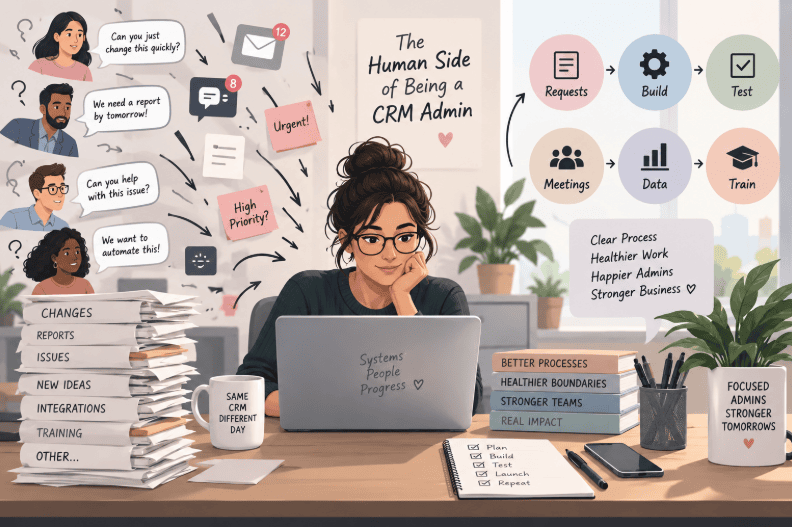
When everything becomes the admin’s job, the problem is not effort. It is missing ownership, prioritization, and process.
What the CRM administrator typically owns
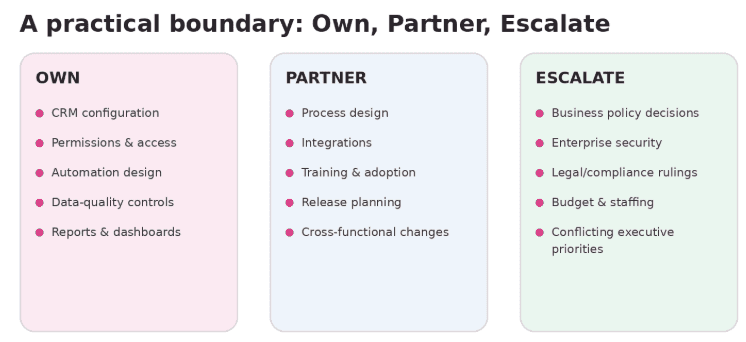
Exact scope varies by company size, platform, technical complexity, and staffing. In most organizations, however, these responsibilities sit squarely within the administrator role:
- Platform configuration. Fields, objects/modules, page layouts, views, workflows, automation, validation, and other configuration that turns business requirements into a usable system.
- Users, access, and permissions. User setup, roles, profiles or permission structures, sharing, and routine access administration within the CRM.
- CRM data quality controls. Validation, duplicate prevention, imports, cleanup processes, required fields, and controls that make CRM data more trustworthy.
- Reports and dashboards. Building and maintaining reporting that helps teams understand activity, pipeline, service, adoption, and other operational measures.
- User enablement and support. Documentation, training, troubleshooting, release communication, and helping users understand how the CRM should be used.
- Platform health and change management. Reviewing vendor releases, testing changes, evaluating impact, managing configuration changes, and reducing unnecessary technical debt.
Important nuance: For cloud CRMs such as Salesforce and Zoho, the admin is generally not installing vendor security patches. The admin monitors releases and required actions, tests impact, adjusts configuration, and prepares users for changes. |
The boundary that matters: business ownership vs. platform ownership
The admin should participate in process design. They may map the current process, identify gaps, propose a better workflow, and explain what the platform can support. What they should not be expected to do is make the underlying business decision on behalf of the department that owns it.
Decision | Business owner | CRM admin role |
Sales stages | Sales leadership / RevOps | Configure stages, automation, validation, reporting, and advise on CRM impact. |
Lead qualification policy | Marketing + Sales / RevOps | Translate the agreed definition into fields, routing, scoring, and automation. |
Discount approval policy | Finance / Sales leadership | Implement approval logic after the policy and authority levels are defined. |
Customer service process | Service leadership | Design the CRM workflow with the process owner and configure it. |
Data definitions | Business data owner / governance | Implement fields, controls, validation, and documentation around the agreed definitions. |
Integrations: admins may build them without owning the entire ecosystem
This is another area where simple job-boundary advice can become inaccurate. CRM admins often configure native integrations, connected apps, authentication, field mappings, sync rules, webhooks, and integration settings. In some organizations, that is absolutely part of the admin job.
The boundary changes when an integration becomes enterprise architecture. If a workflow crosses multiple business-critical systems, middleware, custom APIs, security domains, data warehouses, or applications owned by other teams, the CRM admin should not automatically become the sole owner simply because Salesforce or Zoho is one endpoint.
|
Data quality is not the same as data ownership
Admins frequently carry major responsibility for CRM data quality: validation, deduplication, import controls, field design, cleanup, permissions, and monitoring. But they cannot manufacture good business data by themselves.
The department that creates and uses a business definition should have an accountable owner for that definition. For example, Sales leadership or RevOps should decide what counts as a qualified opportunity; the admin can then make the CRM enforce and report on that definition consistently.
Where role creep usually starts
- “Can you just build this?” A stakeholder brings a solution instead of a problem, and the admin is expected to implement it immediately without discovery or review.
- “You know Salesforce, so you decide.” A business-policy question gets handed to the admin because they understand the system better than the people making the policy.
- “Can you just build this?” A stakeholder brings a solution instead of a problem, and the admin is expected to implement it immediately without discovery or review.
- “It touches the CRM, so it is yours.” Ownership expands from the CRM itself to every tool, integration, process, meeting, and decision connected to it.
- “Can you just build this?” A stakeholder brings a solution instead of a problem, and the admin is expected to implement it immediately without discovery or review.
- “You know Salesforce, so you decide.” A business-policy question gets handed to the admin because they understand the system better than the people making the policy.
- “Can you just build this?” A stakeholder brings a solution instead of a problem, and the admin is expected to implement it immediately without discovery or review.
- “It touches the CRM, so it is yours.” Ownership expands from the CRM itself to every tool, integration, process, meeting, and decision connected to it.
What managers and RevOps leaders should do differently
- Protecting the admin from role creep does not mean reducing their influence. It means giving them the authority and context to do the technical and operational work well while keeping business accountability with the people who actually own the decision.
- Create one intake path for CRM changes instead of allowing every stakeholder to send direct build requests.
- Name a business owner for important processes and definitions before asking the admin to automate them.
- Give the admin access to discovery conversations early, not after a solution has already been promised.
- Prioritize requests. An admin cannot simultaneously treat every department's request as urgent.
- Provide technical support when integrations, security, development, or architecture exceed the admin's role or experience.
- Treat the admin as an advisor. They should be able to say that a requested solution will create technical debt, reporting problems, or unnecessary complexity.
What admins can do when everyone expects them to know everything
You do not need to know every answer immediately to be effective. Strong administrators learn how to turn ambiguous requests into decisions, identify the correct owner, and explain technical tradeoffs in business language.
Ask for the problem before the solution. “What are we trying to change for the user or the business?” is often more useful than immediately accepting a request for a new field, automation, or app.
Separate “I can build it” from “we should build it.” Technical feasibility is only one part of a good CRM decision.
Put decisions in writing. Document the business owner, requirement, expected outcome, and approval for meaningful changes.
Use a parking lot instead of guessing. When a question belongs to Finance, Security, Sales leadership, or another owner, capture it and route it instead of silently taking responsibility for it.
Lead with structure, not performance. You do not have to become the loudest person in the meeting. A clear agenda, good questions, documented decisions, and a concise recommendation are leadership behaviors.
A simple test before assigning work to the CRM admin
- Is this a platform/configuration decision, or a business-policy decision?
- Who owns the business outcome this request is supposed to improve?
- Does the request affect systems or risks outside the CRM?
- Has the requirement actually been agreed upon, or is the admin being asked to settle a stakeholder disagreement?
- Does the admin have the authority, expertise, time, and support required to own this safely?
If those questions reveal a missing owner, the answer is not to make the CRM administrator the owner by default. Assign the missing accountability first, then let the admin do what a strong administrator does best: turn clear business decisions into a system people can actually use.
A good CRM admin does more than click buttons. They translate, advise, design, protect the platform, and help the business make better decisions - without becoming the owner of every decision the business has failed to assign. |
Sources and platform references
Salesforce Trailhead — Salesforce Admin Role: Skills, Responsibilities & More:https://trailhead.salesforce.com/content/learn/modules/salesforce-admin-quick-look/learn-about-the-salesforce-admin-role
Salesforce Trailhead — Explore Core Salesforce Administrative Responsibilities:https://trailhead.salesforce.com/content/learn/trails/explore-core-salesforce-administrative-responsibilities
Salesforce Help — Admin Communications / Release & Maintenance Information:https://help.salesforce.com/s/articleView?id=000336830&type=1
Zoho CRM — Begin Admin Journey:https://help.zoho.com/portal/en/kb/crm/crm-reference/introduction-to-zoho-crm/articles/begin-admin-journey
Zoho CRM — Getting Started Workbook for Admins:https://www.zoho.com/sites/default/files/Getting-Started-Workbook-for-Admins.pdf